
Maricopa, AZ · Garage Door Service
Garage Door Service for Stanfield's 1960s Housing Stock
Stanfield homes mostly date to 1960, older than the rest of our service area. See what that means for your door, your spring, and the repair-or-replace call.
- Repairs & new doors
- Springs & openers
- Serving 3 nearby communities
Where This Job Goes Sideways
Across the area we cover, median household income runs $63,545, and that number is what decides whether a repair makes sense or a door gets replaced outright. Stanfield doesn't have its own income figure in the data we work from, so we price the job the same way we do anywhere in that income band: fix what can be fixed, replace only what's actually worn past the point of parts.
What does separate Stanfield from the rest of the service area is the age of the houses. The median year built here is 1960 - a good three decades older than the 1990 median across the broader service area, where most homes went up between 1960 and 1993. That gap matters. A door and opener installed in a 1960-built house has usually been replaced once or twice already by someone, sometimes with hardware that doesn't match the original rough opening. We see more mismatched springs and retrofitted track in older stock like this than we do in the newer subdivisions nearby.
With only 121 households in Stanfield, this isn't a town with a dedicated crew sitting on a street waiting for calls. It's an 11-mile run from our Maricopa base, and we plan the job knowing that before we ever open the truck.
The Symptom
On a house built around 1960, the door that fails is rarely the original. What you're usually dealing with is a second- or third-generation door bolted onto framing that was sized for something else decades ago. The giveaway is a track that doesn't sit quite square, or a header bracket with extra bolt holes from a previous installer who made do rather than resize.
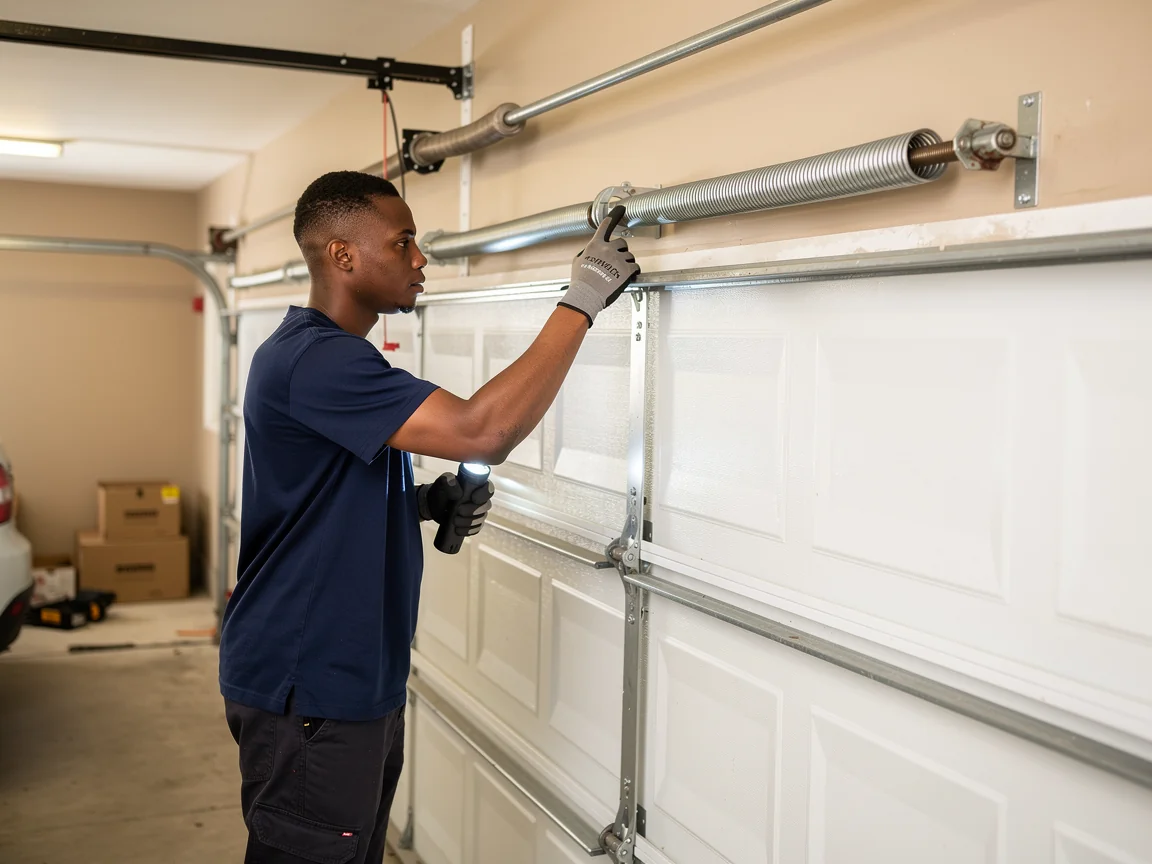
Springs on these older openings tend to be undersized for the door now hanging on them, because somewhere along the way the door got swapped for something heavier - insulated steel instead of the original single-layer panel - without anyone upsizing the spring to match. That shows up as a door that's hard to lift by hand, or an opener straining and burning out faster than it should.
We also see openers mounted on brackets that were never meant for the motor currently installed. It works, until the bracket fatigues and the whole unit starts sagging at the header. None of this is exotic. It's just what happens when a door gets replaced in pieces over sixty years instead of all at once.
Stocked Parts
Because the truck comes from Maricopa, what we carry out to Stanfield is built around what fails most on houses from this era: torsion springs in a range of wire sizes to cover mismatched setups, replacement end bearings, and standard-lift track sections for the older 7-foot openings that show up more here than in newer construction.
What we don't carry as standard stock is anything custom-width or a specialty opener model - if your door was a nonstandard size when someone swapped it in years ago, that part gets ordered, and that means a second trip. We'd rather tell you that up front than pretend every job gets finished in one visit.
Given the severe heat this region sees, we also keep nylon rollers on the truck over steel ones for replacement work - steel rollers tend to go noisy and stiff faster under sustained high temperatures, which matters more here than it would somewhere with a milder climate.
The Cost of This Job
With the service area's median household income at $63,545, the repair-or-replace line usually falls at whether the spring and hardware are salvageable or whether you're looking at a full door replacement because the panel itself is cracked or the track is bent beyond adjustment. On a 1960-era house, that line gets crossed more often than on newer stock simply because more of the hardware has already been patched once.
A straight spring swap on a door that's otherwise sound is the cheapest version of this job. Where it gets expensive is when the door has been resized or re-hung off-spec sometime in the last sixty years - those jobs sometimes need a part ordered rather than pulled off the truck, and that adds a return trip to the bill.
We won't quote a number here that isn't tied to what we see once we're standing in front of the door, because the honest answer depends on whether this is original hardware, a prior retrofit, or something in between.
Frequently asked questions
Do you have a crew based in Stanfield?
No. We cover Stanfield from our Maricopa base, about 11 miles out. There's no local depot here, so every job is a planned truck roll rather than a walk-up stop, which is worth knowing if timing matters to you.
Why does the age of my house matter for a garage door repair?
Stanfield's median year built is 1960, notably older than much of the broader service area. Houses that age have usually had the door or opener swapped at least once, often with hardware that doesn't match the original opening, which changes what the actual fault is.
Will you always recommend replacement on an older door?
No. If the spring and track are salvageable, we repair rather than replace. Replacement only makes sense when the panel or hardware is damaged beyond what a repair can fix, and we'll tell you honestly which situation you're in.
More garage door services in Stanfield
Book garage door service in Maricopa
Call now or request a quote - tell us what the door is doing and where you are.